
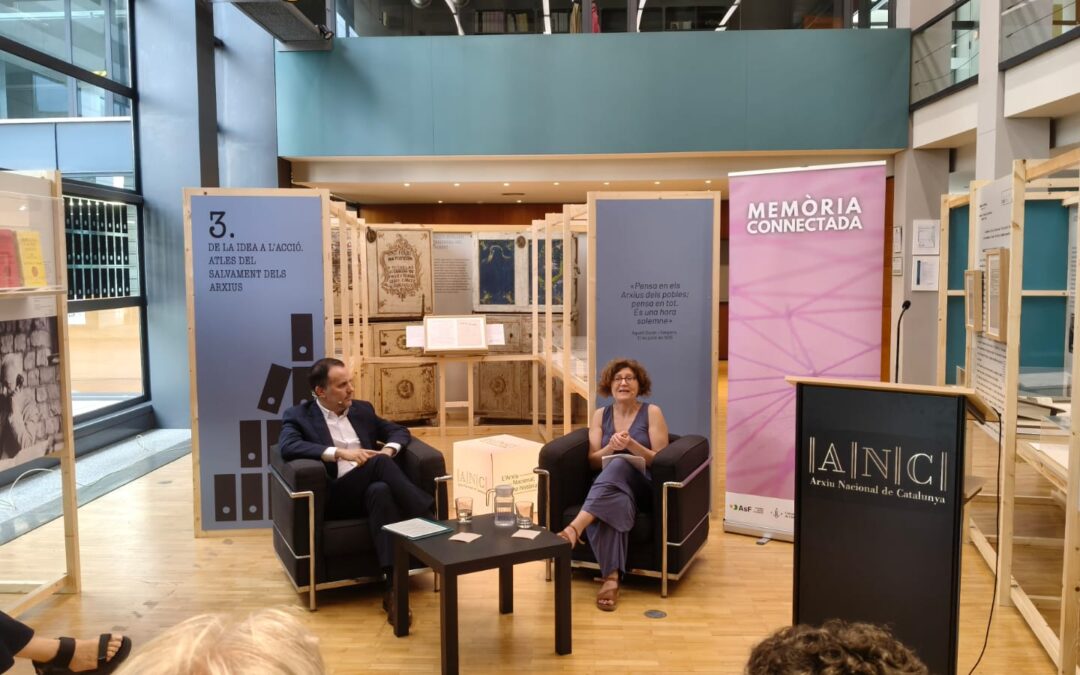
Pepita Raventós, head of the Archives and Document Management service at the University of Lleida, reflects on the event held during International Archives Week and jointly organized by the University of Lleida, the National Archive of Catalonia and Archivists Without Borders.
The conversation “Connected Memory”, held on June 10, 2026 at the National Archive of Catalonia and jointly organized by Archivists Without Borders, the National Archive of Catalonia and the Archives and Documents Management of the University of Lleida, offered a particularly timely reflection on the value of archives in contexts of conflict, vulnerability and the reconstruction of memory.
Carlos Serrano, ALIPH Program Director, emphasized the protection of documentary heritage against wars, catastrophes, and deliberate destruction. Without going into the detailed analysis of each case, the conversation presented the situation in several conflict zones where archives and other memory institutions suffer irreparable damage. His intervention reminded us that protecting archives is not an exclusively technical issue: it means preserving rights, identities, and evidence essential to communities.
Sílvia Marimon, a journalist specializing in historical memory, provided a complementary and, at the same time, critical perspective: documents do not fully acquire meaning if they are not interrogated, contextualized and explained. Preserving them is essential, but so is making visible the stories they contain, especially those that have been silenced or sidelined by dominant narratives.
The dialogue between both perspectives made it clear that protection and dissemination are not separate objectives. Archives must survive, but they must also speak. Only in this way can they become active spaces of justice, knowledge and collective responsibility.
This responsibility challenges both institutions and professionals: it is not enough to simply safeguard documents, but it is also necessary to guarantee their access, understanding and transmission to future generations. At a time when disinformation, forgetting and destruction threaten collective memories, archives become an essential democratic infrastructure.
Recent Comments