
The United Nations has called for recognition of the importance and relevance of human rights in our daily lives, which are increasingly threatened by the effects of the climate emergency.
Taking advantage of this event on the calendar, AsF has spoken about Archives, Human Rights and Climate Change with Claudio Ogass Bilbao, co-chair of the Climate Change Working Group of the International Council on Archives (CCWG-ICA) and doctoral student in Archive Studies at the University of Liverpool. His doctoral thesis deals with the relationship between the national archive and the Chilean state, in order to understand and highlight the feeling of abandonment of Chilean institutions with respect to institutional and community archives. In addition, he has studied the problem of climate change from a Latin American perspective to propose more ecological and resilient archives.
AsF Communication: You consider yourself an “activist archivist.” What do you think archival activism consists of? What does it mean to you?
Claudio Ogass Bilbao : I call myself an activist archivist, since my research and actions aim to drive social and political transformations to improve the precarious situation of archives in Chile and Latin America.
In this sense, I conceive of my main studies as a strategy within archival activism , because I turn to the past not to recover it with the intention of museographic admiration or to preserve it inertly, but so that the archival community can use it as a resource to improve the present and create a better future. There are so many long-standing problems in Latin America that I look to the past and analyze archival history as a source of experiences from the present. Some authors – such as the Canadian archivist Terry Cook – have proposed that the past is our prologue. I would add that the past is also our archive. There are the dreams, hopes, desires and failed projects of our predecessors, which serve as experience to formulate and design ideas, plans, arguments and organizations to create, with the strength of history and memory, an archival institutionality and policy that allows the current archival community to develop its full creative and intellectual potential and improve our activism strategies in the present, uniting the demands of the past with those of the present.
AsF Comunicación : How is your doctoral thesis related to human rights and archives?
Claudio Ogass Bilbao : This is a challenging question. My doctoral thesis aims to comparatively analyze the activity plans to modernize the National Archive of Chile promoted during the administrations of two national conservatives: Juan Eyzaguirre Escobar (1962-1971) and Claudio Vidal Lazo (1971-1973). It is temporally located in a political moment in the country described by historiography as the “era of global planning”, where two democratic and revolutionary governments – the Christian Democracy and the Popular Unity – tried to promote political agendas discussed and sanctioned in government programs in which planning from the State was very important to modernize the country.
This national context coincides with a period in the institutional history of the National Archive in which two directors, with very different work and professional trajectories, promoted demands to build a modern and efficient National Archive that would respond to the needs of the State and to the constraints of the law that mandated the preservation of administrative and historical documents since 1927. Both directors sought an independent building, the creation of regional archives, and the promulgation of an archives law that lived up to the ideas of their time. From an activist perspective, it is interesting to explain and recover the trajectory and content of these archival failures in order to visualize how these plans are linked to the present and to evaluate to what extent past demands are valid.
From an academic perspective, the emphasis of the thesis lies in reconstructing and analyzing the official communication of the directors with the state agencies to explain these failures of the past. The intersection of memoirs, letters and official documents allows us to analyze the arguments used by the directors to promote their demands and, together, the content and frequency of the State’s responses. In this way, we can learn about the State’s archival thinking on archives and demonstrate the State’s lack of concern and disinterest in the National Archive, as well as the lack of priority it gave to public archives. During the decades of the 1960s and 1970s, the institutional problems were the same and were never resolved due to a lack of state will, despite the constant efforts of its directors.
In this sense, the thesis seeks to place the State in the dock of the Chilean archival court to judge what its role was in these failures: did they facilitate modernization or hinder it?
From reading the documents it is possible to reconstruct the chronologies of the procedures with all the institutions with which the directors Juan Eyzaguirre Escobar and Claudio Vidal Lazo interacted to obtain an independent building. Between 1927 and 1984, the National Archive occupied the same institutional space as the National Library and could not comply with the law due to lack of space. This lack of space is what mobilizes the need for the creation of Regional Archives, as well as the promulgation of a legal and regulatory framework. The directors are not only bureaucrats who guard the past, but they try to be architects of the national archival future. Their vision was to create public policies on which value could be generated around the archives. They were not an inert actor, but an active agent within the narrow margins of state institutionality.
AsF Comunicación: Were human rights a priority for the directors of the National Archive of Chile during the period in which they were directors?
Claudio Ogass: The relationship with human rights is not explicit. Neither of the two directors mentions this issue in the documents nor does it use it as an argument before the State to achieve their demands for building, regionalization or reform. In any case, it is possible to infer that there is a concern to preserve the heritage and make it available for use by different audiences. In this sense, it is an interesting hypothesis to propose that there has been a concern for the right of access to information since the 1960s on the part of the national archival bureaucracy. The idea of creating regional archives aims to promote regional history and activate research from universities, promoting regional culture and collective and individual identity.
Furthermore, now that you mention this question, an interesting aspect to highlight is that Director Eyzaguirre launched the first campaign to generate public awareness about the need to properly preserve documents and have a suitable building of his own. In 1962, the General Directorate of Libraries, Archives and Museums (DIBAM) of the Ministry of Public Education – the body on which the National Archives depended – removed warehouses from the National Archives, aggravating the historic space crisis that had plagued the body since 1927. This provoked the director’s defense, who invited journalists to make two reports showing the disaster that this measure caused, added to a fire in October 1962. This can be considered a strategy of “archival advocacy”, that is, the defense and promotion of the importance of archives to audiences other than those who are convinced of their administrative, political and cultural value.
In conclusion, the discourse of human rights during the decades of the 1960s and 1970s did not have a great reception in the thought and language of the directors directly. Its defense did not penetrate the level of the State archival bureaucracy, marginal and peripheral within the State organizational chart. As today, the archives – and, especially, the National Archives – were still seen as a place of research for historians (mainly men) and a repository of the State’s heritage. However, the expansion of access is present there, implicitly, and, therefore, requires greater research.
AsF Comunicació : One of your lines of research and work is climate change. How can we address, at an archival level, the challenge posed by the climate crisis?
Claudio Ogass Bilbao : The first step is to recognize that climate change is a global crisis and a threat that directly affects all areas. It is an inevitable and undeniable reality, supported by the scientific world. A recent example has been DANA in Valencia, but we have many other examples, such as the floods in Copiapó in 2015 and 2017, or hurricanes Irma and Maria in 2017 in Puerto Rico. These phenomena have made us realize the weakness of archives in the face of this threat.
Climate change is a risk multiplier, increasing the types of hazards and their frequency and increasing the levels of vulnerability of archives and the uncertainty of the archival community regarding the future. Adding to the traditional shortcomings of archives.
The climate emergency challenges the archival sector from two perspectives: first, as a threat to the existence, continuity and integrity of archives; and second, as a test for the mission of archival professionals, which is to ensure that different generations of users can use and benefit from archives. In this sense, it is necessary to reconceptualize the professional mission, because, if we want to preserve archives as platforms for intergenerational communication , we must also preserve the planet.
One way to address this problem is through joint and networked work to address and adapt to climate change. The archival community, since the founding of the International Council on Archives (ICA) in 1948, has come a long way in this direction, always promoting an ethical and collaborative spirit. In my view, there are four key steps in which archival science can contribute responsibly:
-
- Research and adaptation: Institutional adaptation strategies need to be developed to move towards more resilient archives. An interesting practice is that of the interdisciplinary group “Map and Investigate Climate Change to Protect Archives”, which uses georeferencing and risk maps to project future challenges.
- Archives as agents of change: We must be aware that archives are also polluting agents and have an influence on the climate shadow. Although we do not yet know the exact impact of the sector, we can begin to take ecological actions and raise awareness in other professional sectors.
- Review of the professional mission : We need to redefine our mission taking into account not only the protection of documentary heritage, but also the preservation of the planet.
- Archives as tools for awareness: All archives can contribute to documenting climate change, locating significant documents to promote environmental awareness, and countering climate denial. This includes the creation of catalogs, indexes, and outreach activities.
AsF Communication : To implement this plan, are we on time or are we already late?
Claudio Ogass: The application of these ideas must be done from an affective responsibility, considering the workloads and context of each archive. The responsibility of a National Archive, with a legal mandate and a stable budget, is not the same as that of a community archive, where the work is done from love and personal commitment. This fact reinforces the importance of collaboration and solidarity within the archival collective. I need to learn from archives that have reacted to disasters and create joint strategies.
Climate change does not respect borders. As an archivist said at a conference in Girona, “your flood is my flood.” Furthermore, solidarity can be an antidote – small but necessary – to neoliberalism and the individualistic tendency that promotes “campi qui puoi”.
AsF Comunicació: Collaboration must come from interdisciplinary networks. What opportunities do you see for collaboration between archivists and specialists in climate change and human rights?
Claudio Ogass: The transversality of climate change affects all aspects. It is a multifaceted problem in which the role of archivists is essential. To promote the fight against climate change, an interdisciplinary response is vital, as shown by the project “Mapear e Investigar el canvi climático per protegre els archivos”, winner of the PCOM-ICA 2023 Program. This project, made up of geologists, archivists, designers and preventionists from Chile and Mexico, seeks to fill a gap in research on climate change in Latin America. Among the actions carried out are a diagnosis of climate perceptions and actions in the National Archives, the analysis of emergency plans and a risk mapping in cities such as Copiapó and Valdivia. A clear conclusion is that Latin American archives are not prepared to face this threat, since no emergency plan mentions climate change.
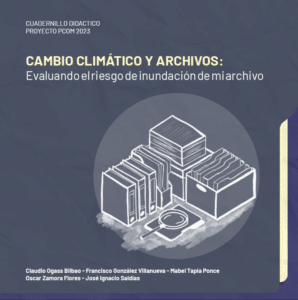
These shortcomings highlight the need for interdisciplinary work and the link between activism and research. Evidence-based research gives us the strength to make demands and generate more realistic and contextual solutions.
Claudio Ogas Bilbao
Co-chair of the Climate Change Working Group of the International Council on Archives (CCWG-ICA) and PhD candidate in Archive Studies at the University of Liverpool
Recent Comments