
The intervention of Archivists Without Borders in the archive of the Casal Català de Tolosa (2023)
Last July 2023, a delegation from Archivists Without Borders (AsF) carried out an intervention in the archive of the Casal Català de Tolosa de Llenguadoc, a prominent association of Catalan cultural actions abroad since the exile of the 1940s, after the Republican defeat of 1939. AsF has maintained contact with those responsible for this entity since 2018 to analyze the value of its documentary collection and advise its managers with a view to its preservation and its suitability for various lines of study.
These contacts, temporarily cut off due to the pandemic, revealed not only an internal interest in this documentation for the knowledge of the organization itself and its members and the human and cultural heritage accumulated throughout its existence, as well as for the good management of its data, assets and legal needs. A public interest was also evident in considering this documentation as an archive in its own right, and treated for this purpose and placed at the service of public consultation. And although the Casal was born in 1954, a considerable part of the correspondence and documentation that forms part of its archive transcends this temporal boundary and is a testament to the vicissitudes of the first years of exile in France, and, therefore, to the political, economic, cultural and sentimental motivations of those who would later found the Casal, as well as those of many others who, having embarked on the path to France, came into contact with the members of the Casal and found support or guidance there.
All these assessments motivated a reconnaissance and diagnostic visit in 2022, a milestone from which the concretization of a more exhaustive intervention on the archive by two AsF cooperators was planned in 2023, which would become a reality thanks to the support of a subsidy from the Department of Foreign Action and European Union of the Generalitat of Catalonia and the reciprocity of the members of the Casal. The need for this intervention was based on the observation of the problems of this archive; problems, on the other hand, common in popular associations: although their legacy, crystallized in a not inconsiderable documentary volume –up to 13 linear meters of paper but also of photography–, has been possible thanks to the voluntary dedication of its members, very often this has been reflected in a diversity of criteria in the organization and installation of the documentation, usually without a knowledge of coherent archival methods, which do not achieve an order of the archive that makes it possible to consult it successfully and to preserve it safely.
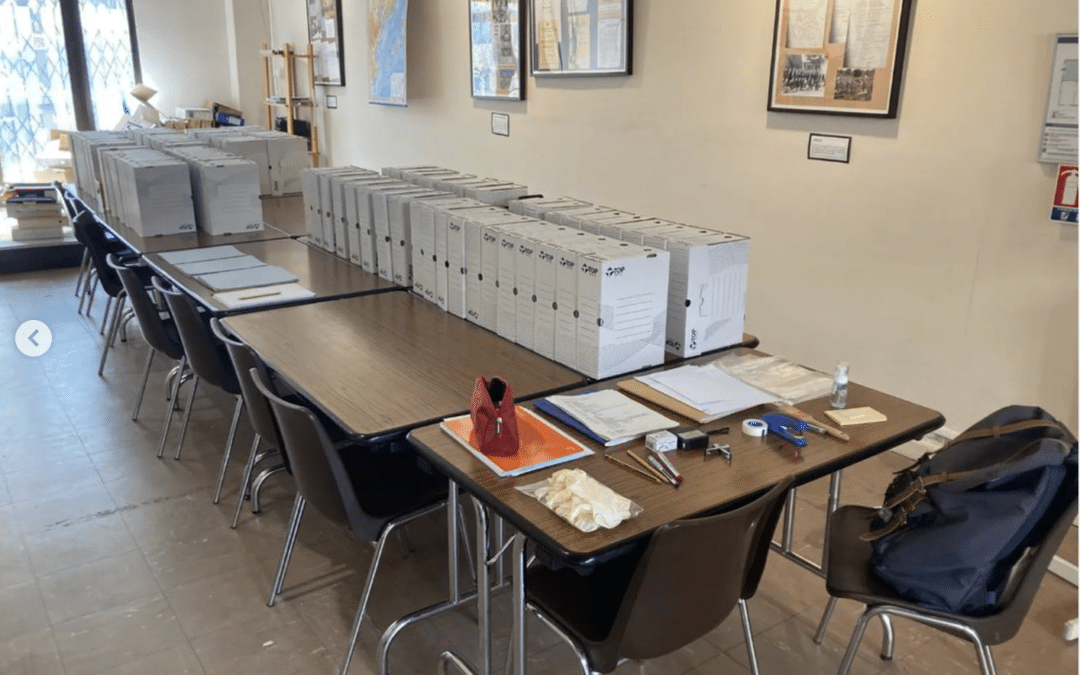
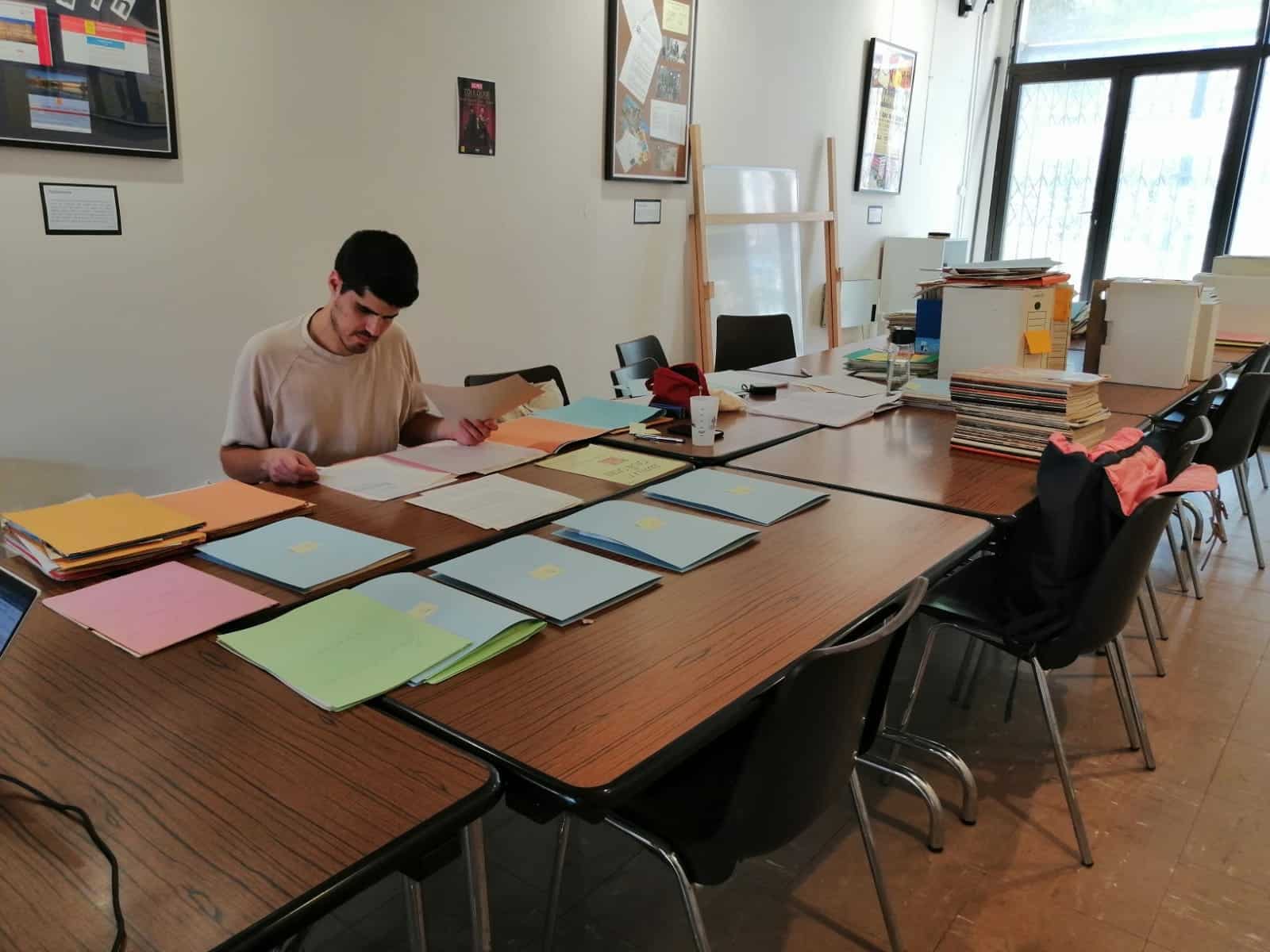
The lines of action, then, were clear: the emptying of the archive, the elimination of everything external to the documentary collection, without authentic or representative value for the entity; and the study of the documentation to determine a classification by functions and subfunctions according to the model that is the Classification Table for cultural entities and associations of the Directorate General of Cultural Heritage [1] . Based on this organizational scheme, the determination of the main documentary series and their inventory, with the deepest possible level of description based on the time available, and the installation of the documentation already processed, grouped in folders and stored in labeled archive boxes, under the control of a topographical code.
These works, carried out over ten days, resulted in the installation of an archive of 9.3 linear meters, consisting of 93 regular and topographic installation units and linked in a classification table that gave the entity the key to access the main areas of its documentary collection, such as all the documentation relating to its constitution and internal management, accounting, and correspondence. Furthermore, even in the case of some specific documentary series, priority was given to deepening the description and organization of the documentation, as is the case with everything related to the Sardana Gathering, the most emblematic activity of the Casal and continued over time, or the Casal Bulletin, published since 1963.
The general state of disorder of the archive before the intervention made it necessary to devote most of the time to the classification by large documentary areas and to guarantee an adequate installation, highlighting some points of interest, but without achieving the complete description and arrangement of all the documentation. It would be desirable for this objective to be the focus of a second intervention in this archive.
Meanwhile, the visit of Archivers without Borders to the Casal Català de Tolosa will have provided the entity with a global knowledge of its documentary heritage, its scope and its gaps and unknowns; a knowledge that may attract its study, and that will reinforce the awareness of its value: a thread that links the adventures of the first generation of Catalan exiles with those of new generations of expatriates who have rediscovered a shared fund in the memory of the Casal.
[1] Cobo Barri, E., Pedrals Costa, X., Vilarrúbias Cuadras, Yáñez Navarro, M., (2023). Support protocol for the archives of cultural entities and associations. Archiving and document management. Tools , 11.
Recent Comments